Plant Description:
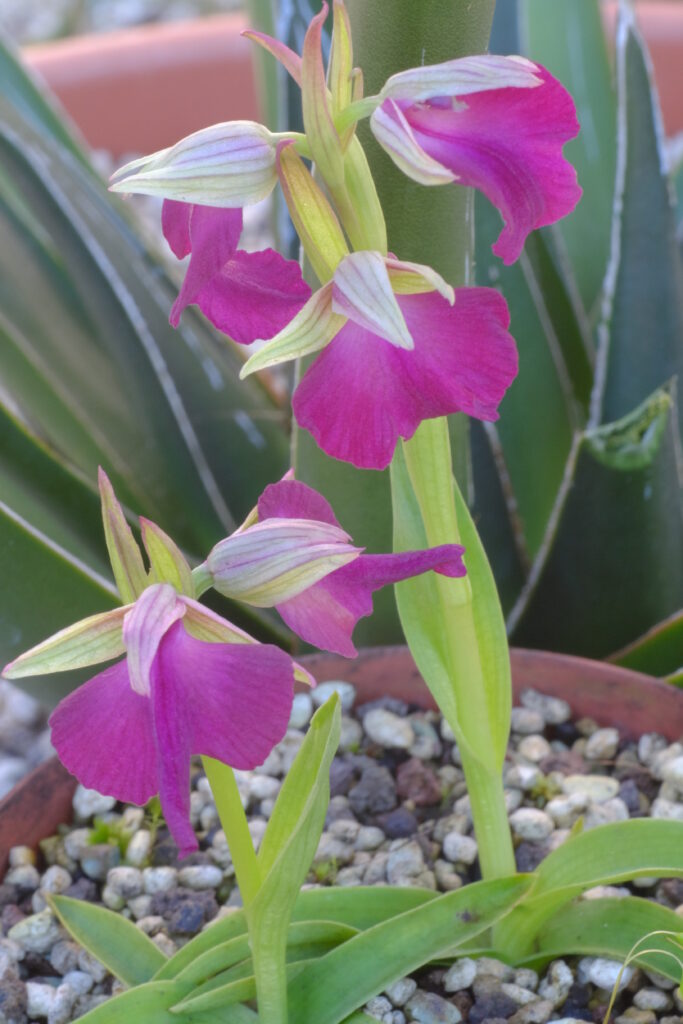
The genus *Serapherorchis* has not yet been formally published. Therefore, *Serapicamptis* is commonly used. *Serapicamptis* are primary hybrids between the genera *Anacamptis* (*Orchis*, *Herorchis*) and *Serapias*. All species of the genus *Anacamptis* (as defined by Pridgeon et al. 1997) with 2n=36(32) chromosomes are compatible with *Serapias* (2n=36). The species remaining in the genus *Orchis* have 2n=42 chromosomes and are not compatible with *Serapias*. In hybrids, *Serapias* is the dominant parent, and the offspring exhibit the habit of a *Serapias*. The hybrids are large-flowered and often very attractive.
Cultivation:
Serapicamptis is easy to care for. All plants are dormant in summer and survive as small tubers (tuberoids). The leaves appear in late summer or autumn, and the plants flower in spring or early summer. Prefers a sunny location. Cultivation in gardens is possible in Central Europe. Hardy down to -10°C (14°F), with a Central European parent. To avoid severe frosts, the plants should be given some protection during the coldest months. Serapicamptis prefers well-drained soil when grown outdoors. Regular watering during the growing season is essential for successful cultivation in pots. Watering is reduced once the flowers appear and finally stopped completely once the plants die back. Potted plants should be kept completely dry during dormancy. However, small plants and seedlings should receive occasional watering in summer to prevent them from drying out. Plants grown in the garden need very well-drained soil; then even summer rain won't harm them. If the plants are kept indoors, they should be moved outdoors temporarily in late summer. Cool nights and some rain bring an end to the summer dormancy and stimulate the plants to new growth.
Recommended soil mixtures:
An organic mixture of 50% wood fiber blended with 50% commercial potting soil, or a mineral (80%–90%) mixture with low organic content. Depending on availability, volcanic grit, volcanic stratification, Seramis, or pumice with 10% to 20% organic components can be used. Wood fibers, TKS1, Floraton 3, or similar propagation substrates are suitable. The substrate must be well-draining with a pH of approximately 6.
Recommended reading:
Orchids of Britain & Europe. Pierre Delforge, 1995. Collins Photo Guide. ISBN 0 00 2200244.
Orchideen im Garten: Use, care and propagation. Gerd Kohls and Ulrich Kähler, 1993. Parey ISBN 3 489 636244.
Orchideen für den Garten: European and tropical terrestrial orchids. Alfons Bürger, 1992. Ulmer ISBN 3 8001 64876.
Hardy orchids. Phillip Cribb and Christopher Bailes, 1989. Timber Pr. ISBN 0 88192 147 5.