Distribution:
Tongue-shaped plants are widespread throughout the Mediterranean and are found especially in coastal regions.
Plant Description:
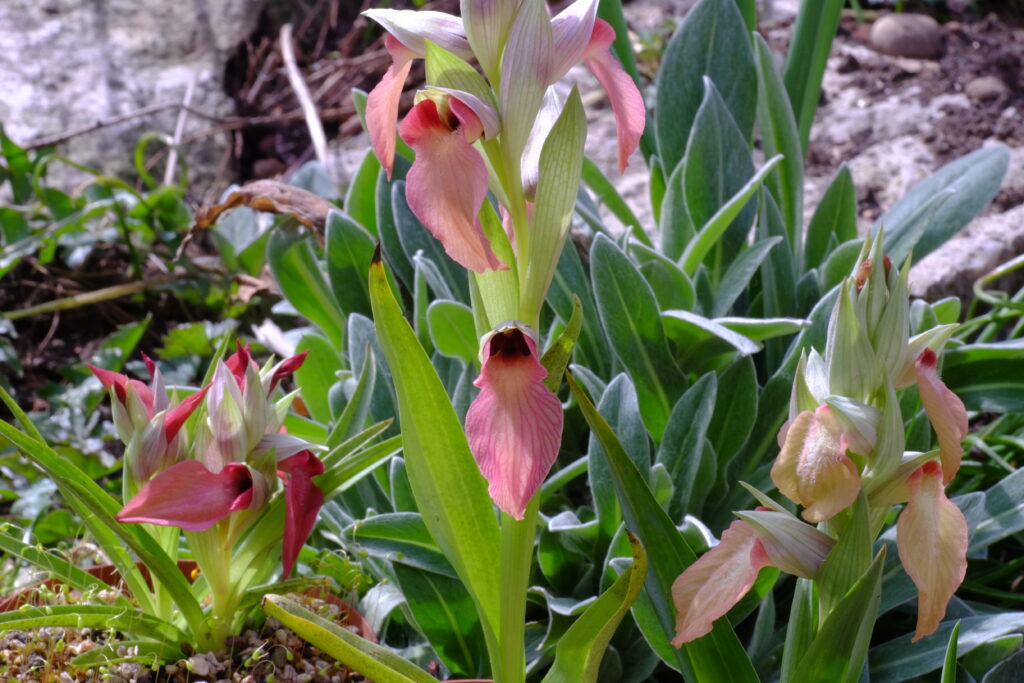
More than 50 species exist, including numerous new and undescribed varieties. The leaves are narrow and basal. The flowers are often large. Sepals and petals together form a tube from which the conspicuous lip emerges. It is widely assumed that the plants are pollinated by insects seeking shelter or roosting in the tube. However, this is contradicted by the fact that many Serapias species emit various fragrances in warm, sunny weather.
Cultivation:
Serapias is easy to care for. All plants are dormant during the summer and survive as small tubers. The leaves appear in late summer or autumn, and the plants flower in spring or early summer. They prefer a sunny location. Regular watering during the growing season is essential for successful cultivation. Watering is reduced once the flowers appear and finally stopped completely once the plants go dormant. They should be kept completely dry during dormancy. However, small plants and seedlings should occasionally receive a little water during the summer to prevent them from drying out. They are hardy down to -6°C (23°F).
Recommended soil mixtures:
Organic, 50% wood fiber mixed with 50% commercial potting soil, or mineral (80%–90%) with low organic content. Depending on availability, volcanic grit, volcanic stratification, Seramis, or pumice with 10% to 20% organic components can be used. Wood fibers, TKS1, Floraton 3, or similar propagation substrates are suitable. The substrate must be well-draining with a pH of approximately 6.
Species – Remarks on the plants offered:
Serapias orientalis X Serapias neglecta. This hybrid has not yet flowered. Large, fragrant blossoms are expected. Both parent plants produce pleasant, yet very different, fragrances in warm weather. The plants are vigorous growers.
Serapias lingua. These plants reproduce readily vegetatively and reliably produce large, pink, fragrant flowers in warm weather. This clone is widespread in Australian collections.
Recommended reading:
Orchids of Britain & Europe. Pierre Delforge, 1995. Collins Photo Guide. ISBN 0 00 2200244.
Orchideen im Garten: Use, care and propagation. Gerd Kohls and Ulrich Kähler, 1993. Parey ISBN 3 489 636244.
Orchideen für den Garten: European and tropical terrestrial orchids. Alfons Bürger, 1992. Ulmer ISBN 3 8001 64876.
Hardy orchids. Phillip Cribb and Christopher Bailes, 1989. Timber Pr. ISBN 0 88192 147 5.
Die Orchideen Mitteleuropas und der Alpen. Presser Helmut, 1995. ecomed, ISBN 3 609 65600 X
Guide des orchidées d’Europe, d’Afrique du Nord et du Proche-Orient. Pierre Delforge, 2016. ISBN / EAN: 9782603012284
Orchids of Europe, North Africa and the Middle East.CAJ KREUTZ, 2024 Kreutz Publishers. ISBN 978-90-831411-2-1.