Distribution: Euro-Mediterranean, from the Canary Islands to the Caucasus, and in the north to southern Scandinavia.
Plant Description: Inflorescences 5 to 80 cm tall, with a rosette of leaves, though in some species this rosette dissolves during flowering. Ophrys has few, small to medium-sized flowers. The labellum is always spurless. The flower segments are spreading. All species are sexually deceptive flowers, mimicking female insects and being pollinated by males.
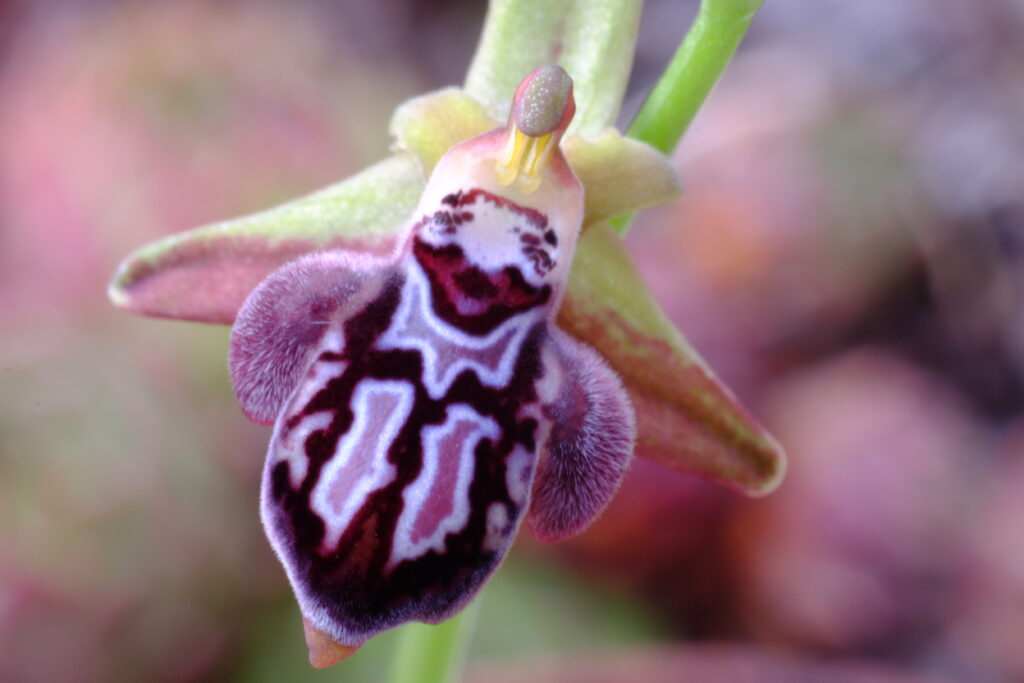
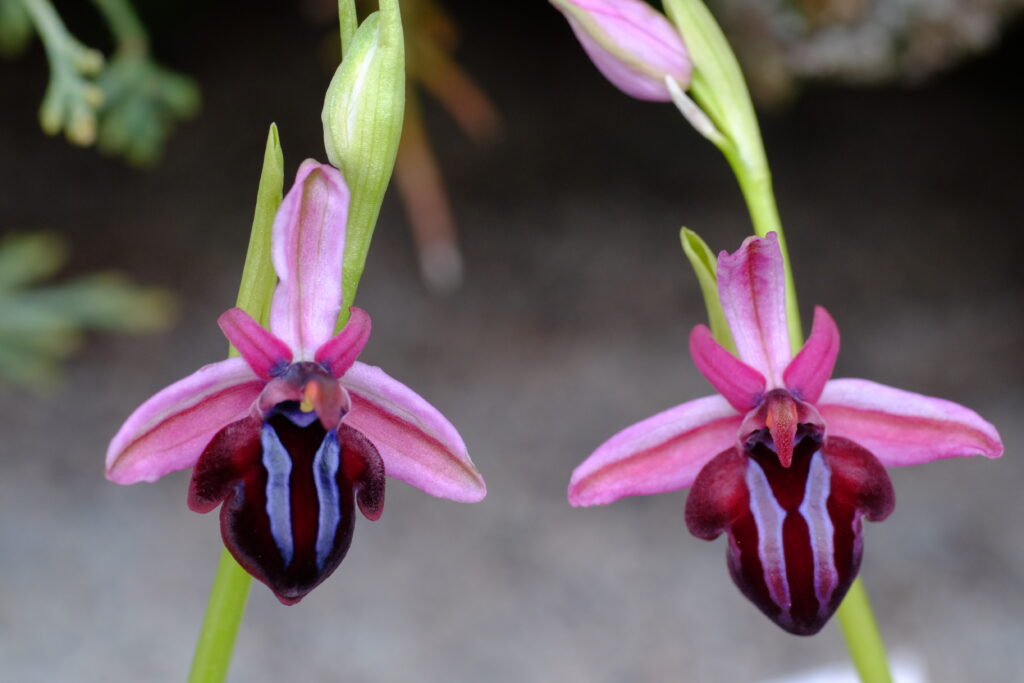
Ophrys ariadnae
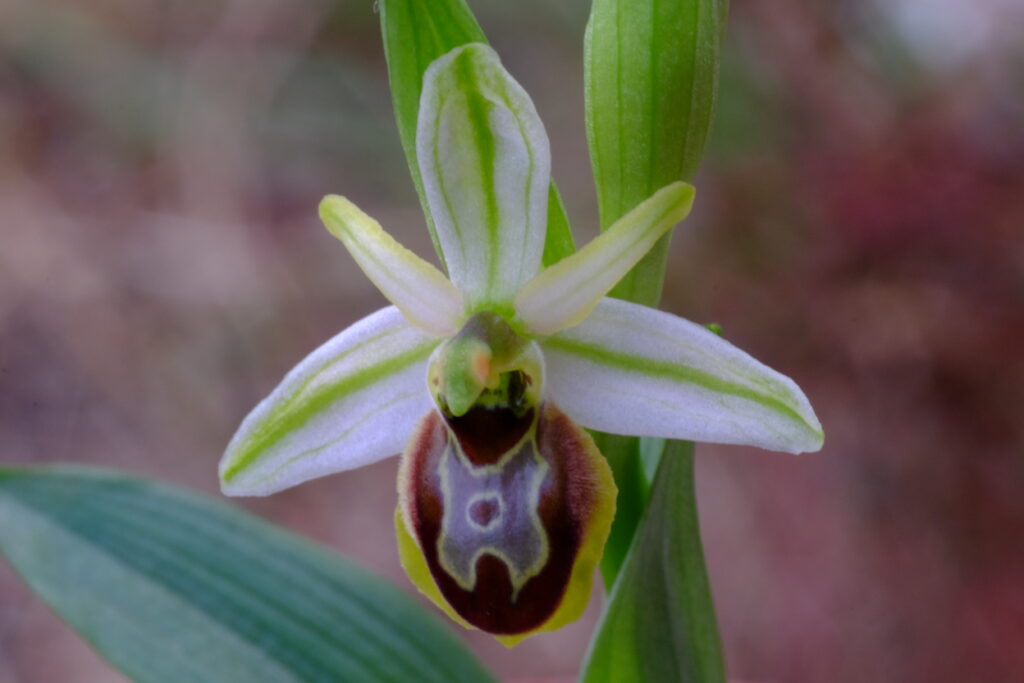
Ophrys splendida
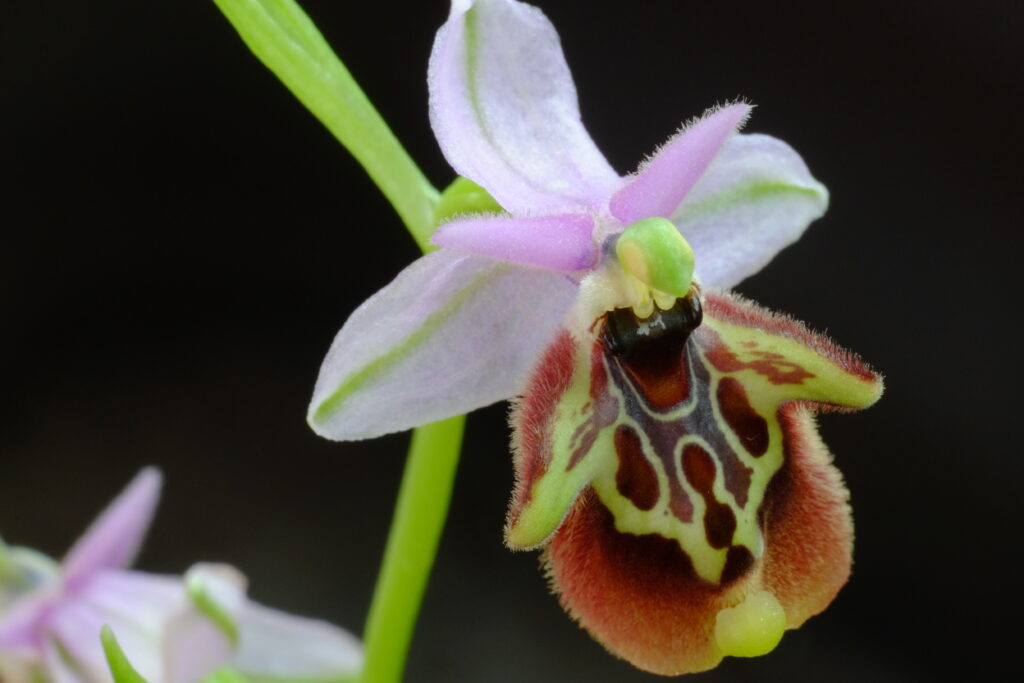
Ophrys lyciensis
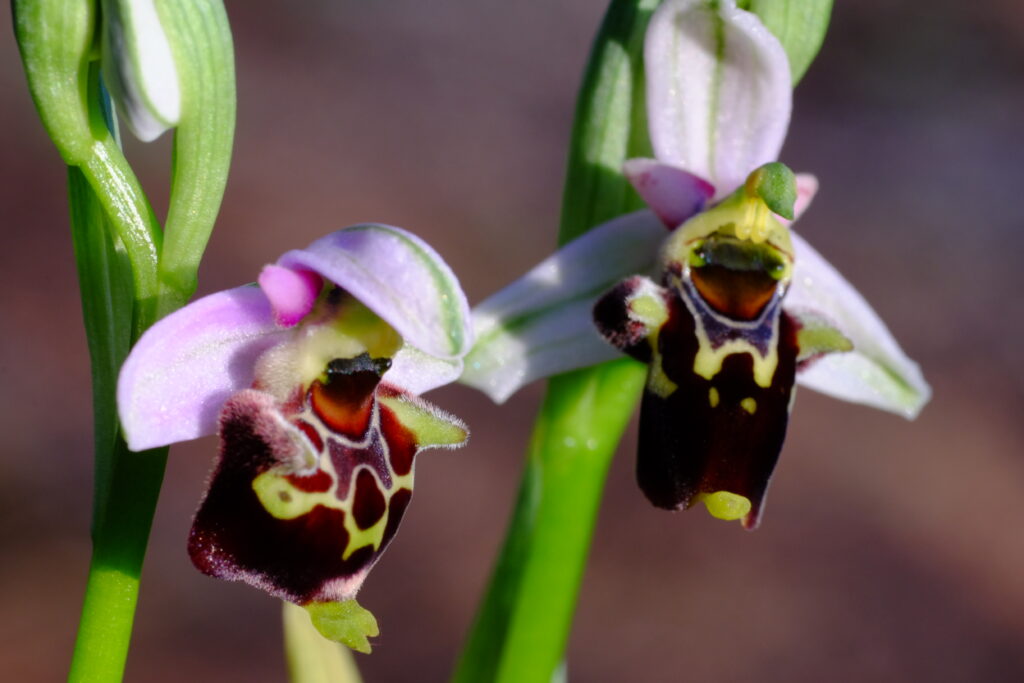
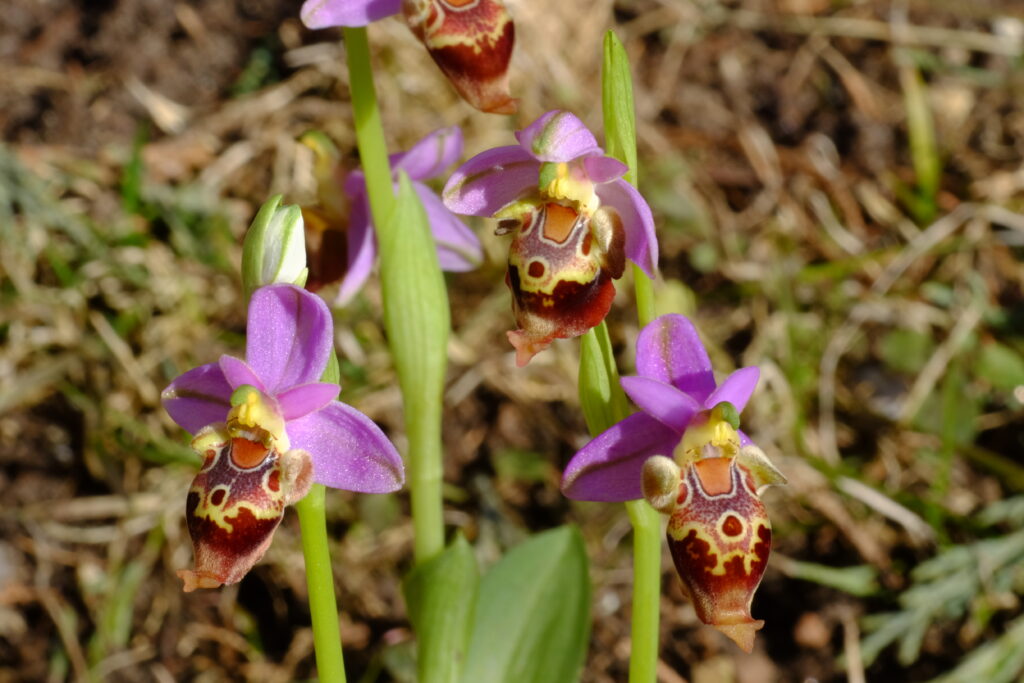
Ophrys apifera x holosericea
Ophrys heldreichii
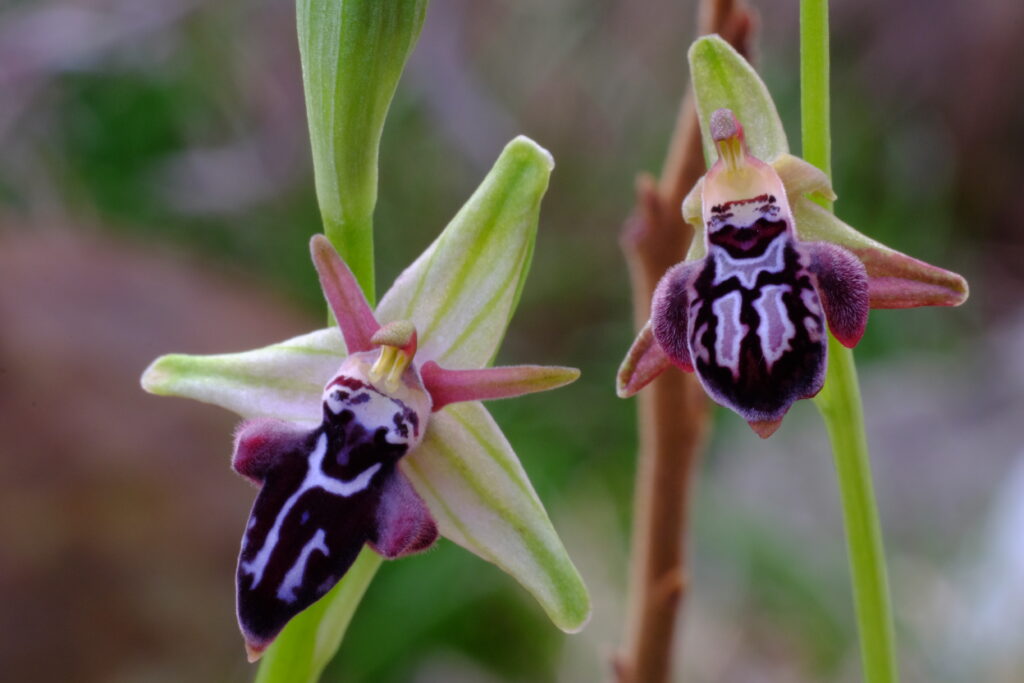
Ophrys cretica (left) and Ophrys ariadnae
Cultivation: Ophrys is somewhat more difficult to cultivate than Anacamptis, but still quite manageable. The plants require a summer dormancy and survive as small tubers. The leaves appear in late summer or autumn. The plants flower in winter, spring, or early summer. Cultivate in as sunny a location as possible. Frost hardiness varies between species. They are hardy down to -4°C (Mediterranean species and races of the Ophrys fusca group) or down to -18°C (Ophrys insectifera). For some species, year-round cultivation in Central Europe is possible. To avoid severe frosts, some protection is necessary in winter. Regular watering during the growing season is essential for successful cultivation in containers. Fertilize with 0.2g/l until flowering. Once flowers appear, watering is reduced and finally stopped completely once the plants die back. Keep containers completely dry during dormancy. However, small plants and seedlings should receive occasional watering in summer to prevent them from drying out. Plants grown in the garden need very well-draining soil; then even summer rain won't harm them. If the plants are kept indoors, they should be temporarily moved outdoors in late summer. Cool nights and a little rain will end their summer dormancy and stimulate new growth.
Ophrys normanii (left), Ophrys normanii x chestermanii
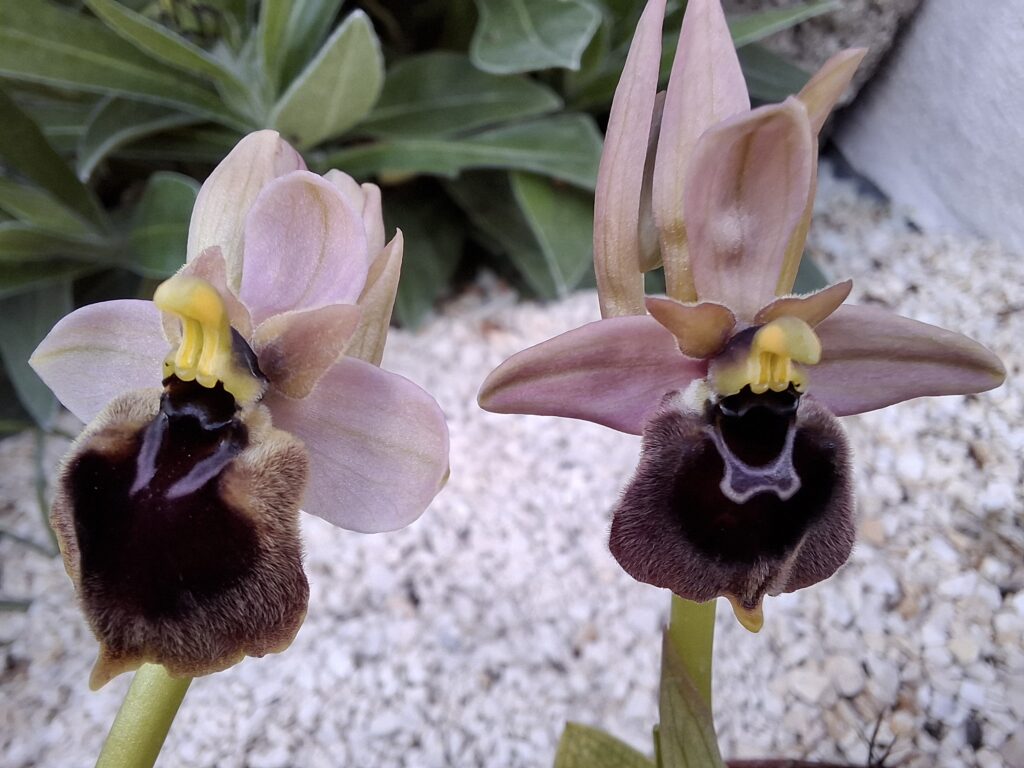
Ophrys sprunerii
Recommended soil mixtures: 50% wood fiber mixed with 50% commercial potting soil or mineral (80%–90%), with volcanic granules, Seramis, or pumice depending on availability. (10% to 20% organic components.) Suitable substrates include wood fiber, TKS1, Floraton 3, or similar propagation mixes. The substrate must be well-draining with a pH of approximately 6.
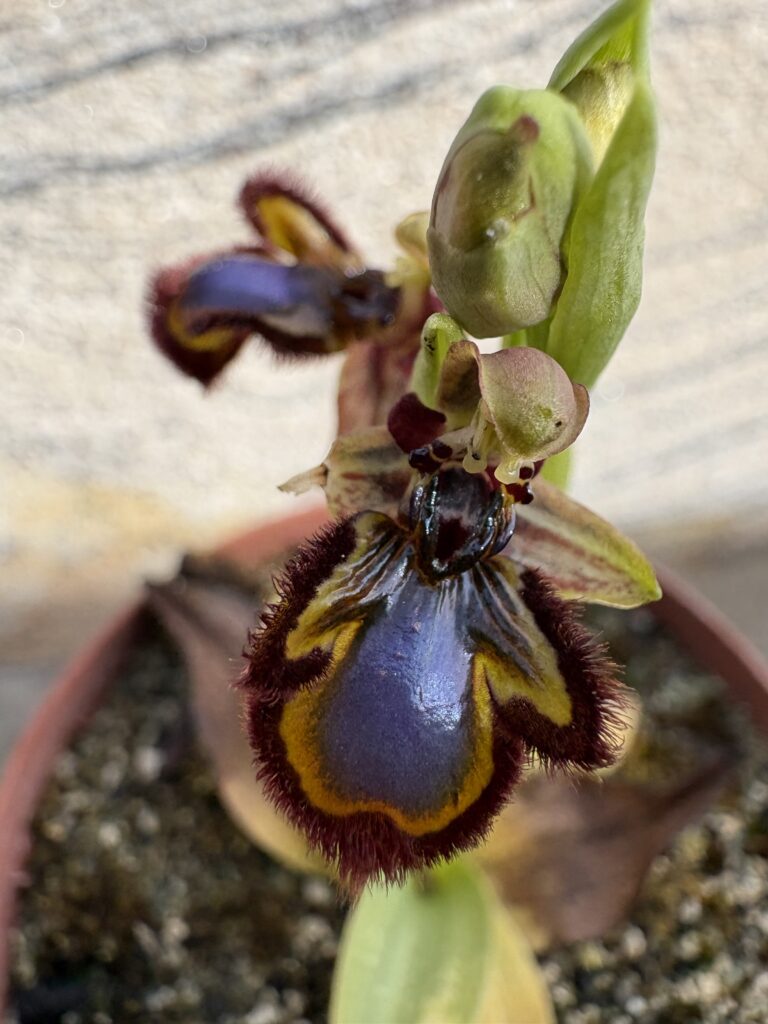
Ophrys speculum
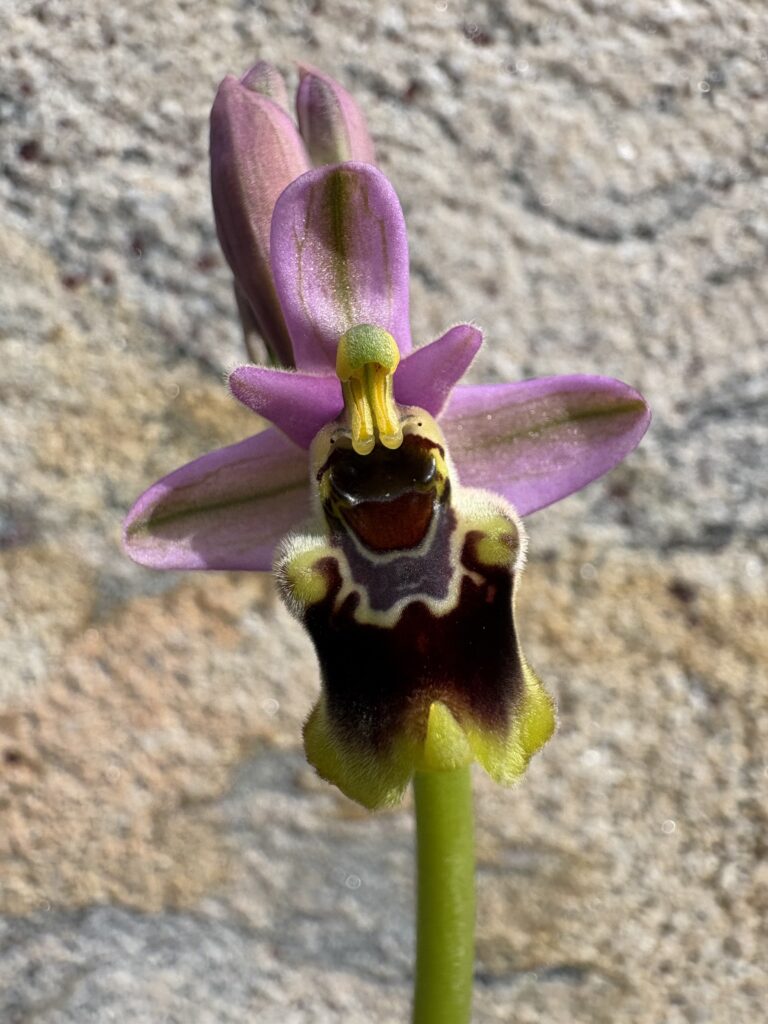
Ophrys tenthredinifera x holosericea
Species – Remarks on the offered plantn
Ophrys heldreichii. A large-flowered and beautiful Ophrys from Crete. Hardy down to -6°C. Ophrys lutea. The true large-flowered Ophrys lutea from the western Mediterranean region. It is easily distinguished from closely related species by its lemon scent. Hardy down to -4°C. Ophrys reinholdii. Large, very dark flowers on tall stems. Hardy down to -6°C. Ophrys apifera hybrids. One parent is always the Central European bee orchid (Ophrys apifera). These are very beautiful and relatively easy-to-grow plants. Most Ophrys apifera hybrids are frost-hardy down to -10°C. Ophrys fuciflora hybrids. One parent is always the Central European bumblebee orchid (Ophrys fuciflora). The characteristics of Ophrys fuciflora are only weakly expressed in its hybrids; it is hereditarily recessive. These are relatively easy-to-grow plants with large flowers. Most Ophrys fuciflora hybrids are frost-hardy down to -10°C. Ophrys insectifera hybrids. One parent is always the Central European fly orchid (Ophrys insectifera). Relatively easy to cultivate, with distinctly insect-like flowers. Ophrys insectifera is often the dominant parent in terms of flower shape. The size of the labellum is intermediate between the parent species. Ophrys insectifera hybrids are frost-hardy down to -12°C. Ophrys sphegodes hybrids. One parent is always the Central European spider orchid. It's fairly easy to grow. Most Ophrys sphegodes hybrids are frost-hardy down to -12°C. Ophrys sphegodes X speculum. A large, beautiful lip. The markings sometimes resemble letters. Frost-resistant down to -10°C. Ophrys fuciflora X heterochila. Early flowering, outdoors from the end of April. The bumblebee inherits the large flower trait. Very similar to O. heterochila, forming groups. Relatively little variation. Ophrys apifera X reinholdii. Blooms outdoors from the end of May to the end of June. Large, bee-like flowers.
Recommended reading: Orchids of Britain & Europe. Pierre Delforge, 1995. Collins Photo Guide. ISBN 0 00 2200244. Orchideen im Garten: Use, care and propagation. Gerd Kohls and Ulrich Kähler, 1993. Parey ISBN 3 489 63624 4. Orchideen für den Garten: European and tropical terrestrial orchids. Alfons Bürger, 1992. Ulmer ISBN 3 8001 6487 6. Hardy orchids. Phillip Cribb and Christopher Bailes, 1989. Timber Pr. ISBN 0 88192 147 5. Guide des orchidées d’Europe, d’Afrique du Nord et du Proche-Orient. Pierre Delforge, 2016. ISBN / EAN: 9782603012284 Orchids of Europe, North Africa and the Middle East.CAJ KREUTZ, 2024 Kreutz Publishers. ISBN 978-90-831411-2-1.
Manage consent
To provide you with an optimal experience, we use technologies such as cookies to store and/or access device information. If you consent to these technologies, we can process data such as browsing behavior or unique IDs on this website. If you do not give or withdraw your consent, certain features and functions may be affected.
Functional
Always active
Technical storage or access is strictly necessary for the legitimate purpose of enabling the use of a specific service expressly requested by the subscriber or user, or for the sole purpose of carrying out the transmission of a message over an electronic communications network.
Preferences
The technical storage or access is necessary for the legitimate purpose of storing preferences that were not requested by the subscriber or user.
Statistics
Technical storage or access that is solely for statistical purposes.Technical storage or access is used solely for anonymous statistical purposes. Without a subpoena, the voluntary consent of your internet service provider, or additional records from third parties, the information stored or retrieved for this purpose cannot generally be used to identify you.
Marketing
Technical storage or access is required to create user profiles, to send advertising, or to track the user on one or more websites for similar marketing purposes.