Distribution:
More than sixty species are endemic to Australia. One species is restricted to Timor.
Plant Description:
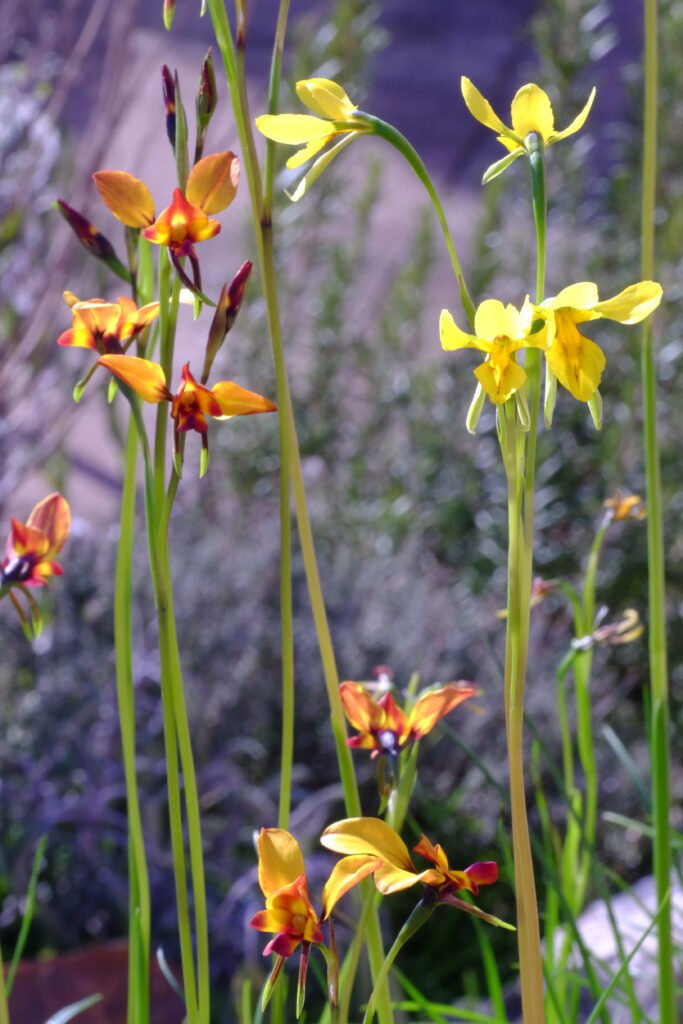
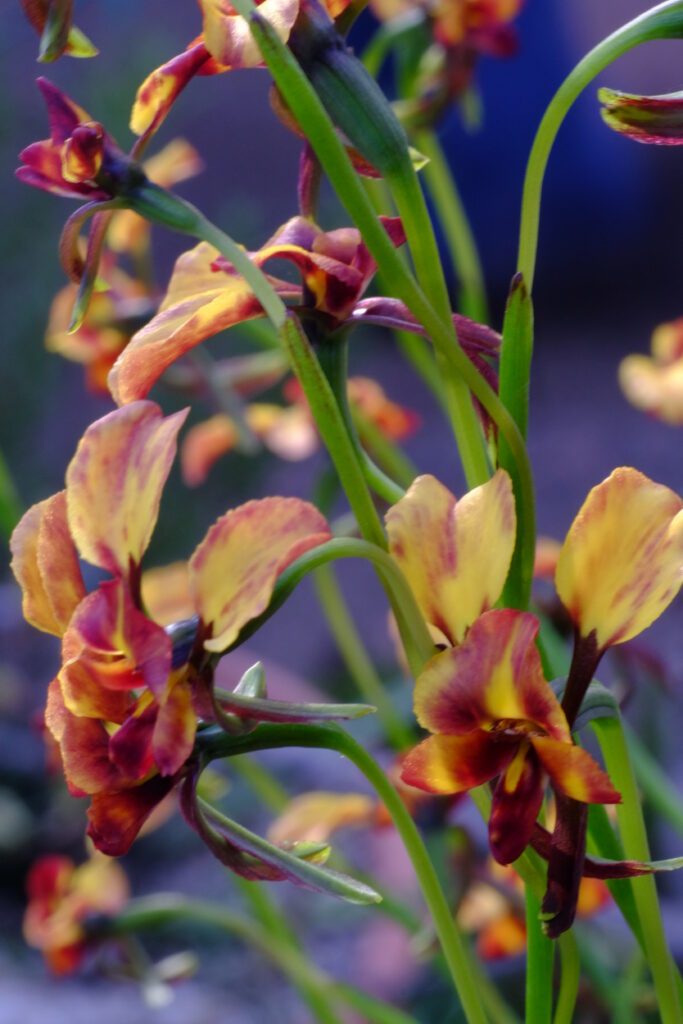
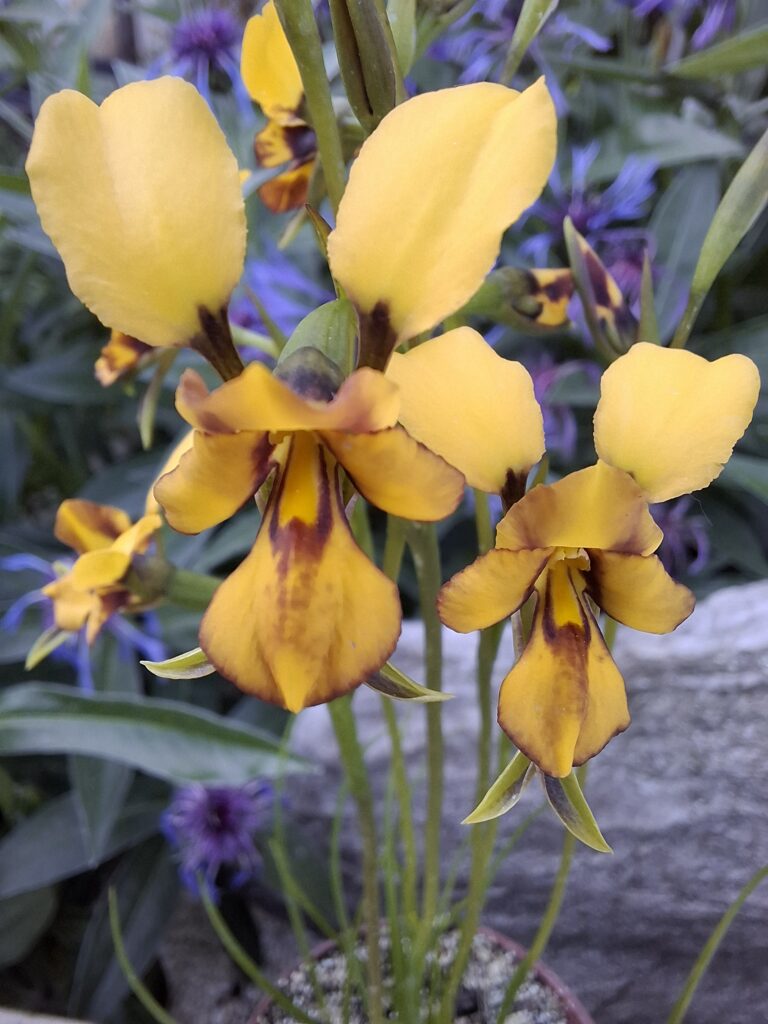
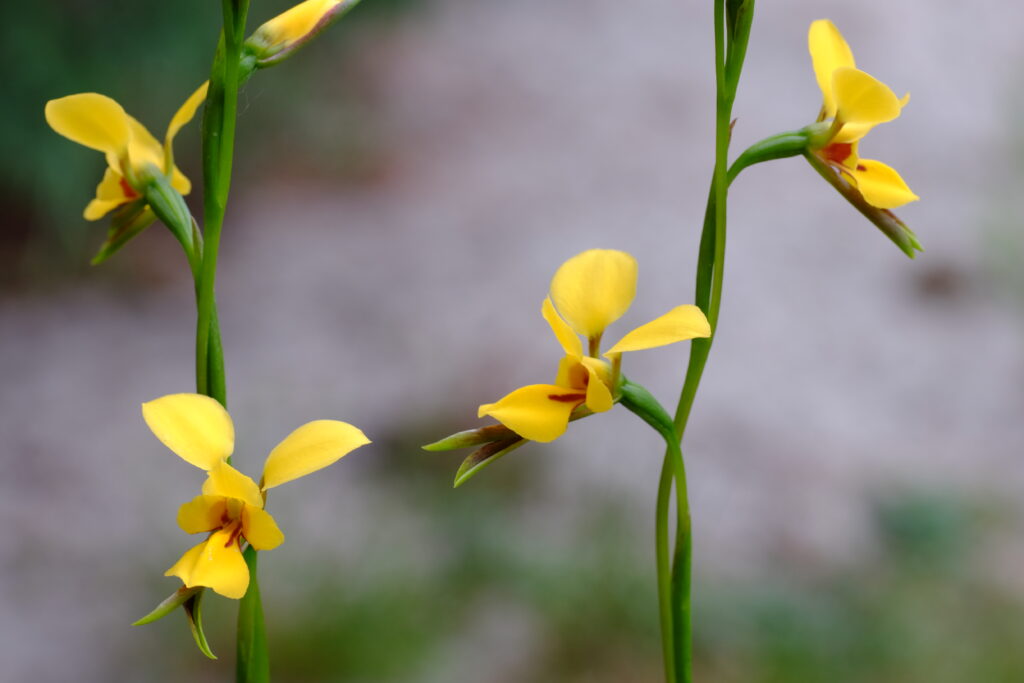
Inflorescences 10 to 100 cm tall, with 1, 2, or 3, sometimes up to ten, grass-like leaves. Up to 10 colorful and decorative flowers with 2 rounded, ear-like petals (donkey ears) above the labellum and 2 long, slender sepals (double tail) below the labellum. The flowers mimic nearby flowering legumes (papilionaceous flowers) and are pollinated by small bees.
Cultivation:
Donkey orchids are easy to cultivate. All plants are dormant in summer and survive as round or oblong, finger-like tubers. The leaves appear in late summer or early autumn, and the plants flower in late winter, spring, or early summer. Cultivate in as much sun as possible. They are surprisingly frost-hardy down to -4°C (29°F). In mild regions, year-round outdoor cultivation is possible even in Central Europe. Regular watering during the growing season is essential. With the appearance of flowers, watering is reduced and finally stopped completely once the plants go dormant. Summer rain is not harmful to garden plants, provided the soil is very well-drained. Potted plants should be kept completely dry during dormancy. However, small plants and seedlings should receive occasional watering during the summer to prevent them from drying out. Indoor plants should be temporarily moved outdoors in late summer. Cool nights and some rain will end their summer dormancy and stimulate new growth.
Recommended soil mixtures:
80 to 90% mineral, depending on availability. Volcanic aggregate, volcanic stratification, pumice, Seramis, 10 to 20% acidic organic components. Rhododendron humus has proven effective. The potting soil must be well-draining, with a pH of 5 to 6. An organic substrate consisting of 90% rhododendron humus with 10% mineral components also yields good results. For mineral substrates, fertilize with slow-release fertilizer. Approximately 1g of Klanz autumn fertilizer per plant. See also potting soil.
Remarks on the plants offered
Diuris brevifolia: Endemic (found only there) to a small area in southern Australia, where it grows in open eucalyptus forests. Late-flowering, in Central Europe from May to June.
Diuris emarginata X orientis: This hybrid uses pollen from a pure yellow form of Diuris orientis (formerly D. corymbosa). It flowers in May. Like other late-flowering exotic terrestrial orchids from Australia or South Africa, these are placed outdoors in a sunny spot from mid-April onwards. This results in more vibrant stems and flower colors, and the plants bloom for several weeks. The new tubers also grow larger because the plants die back later and remain green longer compared to those cultivated in a greenhouse. Light late frosts in May are not harmful if the plants have already been outdoors for several weeks and are therefore hardened off.
Diuris aurea X alba: One of the most beautiful Diuris hybrids. Clear yellow flowers on tall stems. Blooms in greenhouses in Central Europe in March for 3 to 4 weeks. Both parents are closely related and the hybrid is fertile.
Recommended reading:
Cultivation of Australian native orchids produced by the Australasian Native Orchid Society, Victorian group Inc. Helen Richards, Rick Wootton, Rick Datodi.
Orchids of Western Australia produced by the Western Australian Native Orchid Study and Conservation Group. Kingsley W. Dixon, Bevan J Buirchell, Margret T. Collins
Native orchids of Australia. David Jones, 1993. Reed, ISBN 0 7301 0189 4.
Orchids of south-west Australia. Noel Hoffmann and Andrew Brown, 1992. University of Western Australia Press, ISBN 1 875560 13 0.