Distribution:
More than 130 species are endemic to Africa. They are found in highlands of Central and East Africa, and also in lower-lying regions of South Africa. Some species are found in Madagascar.
Plant Description:
The individual sections within the genus Disa are very diverse. In cultivation, only Disa uniflora and its hybrids within the section Disa are widespread. Disa flowers are very distinctive. The dorsal sepal is conspicuous and spurred. The lip, on the other hand, is small or very small and often recessed within the flower.
Available options:
Disa crassicornis:
Section Hircicornes. Robust plants, up to 60 cm tall, with very large flowers. The 4 to 5 oblong basal leaves are lightly to heavily spotted and resemble Dactylorhiza. Flowers are white to cream-colored with pink or purple spots and pleasantly fragrant. Flowering time in the Northern Hemisphere is June to July.
Cultivation:
Disa crassicornis grows in the Drakensberg Mountains of South Africa at altitudes of approximately 1000 to 2700 meters. Winters are cold and dry, while summers are warm and humid. During dormancy (November to March in the Northern Hemisphere), the plants should be kept cool and dry, but the soil should not be allowed to dry out completely. New leaves appear in a conservatory in March/April. The flower spike then develops from the overwintered rosette. Overwintered leaves remain green until the end of summer, for a total of 15 to 18 months. Outdoors, the leaves freeze at temperatures below -7°C. New leaves then do not appear until the end of May. Once the leaves emerge, water regularly and keep the soil moist. The new rosette develops from June onwards. Potted plants should be kept slightly submerged in a saucer. Fertilize monthly with 0.2 g/l of fertilizer during the summer months. Cultivate in full sun during the summer; during dormancy, a darker location is acceptable. Well-suited for garden cultivation. The plants survived the last few winters in the garden without any losses, thanks to light protection. To be on the safe side, the soil should be protected from severe frosts.
Recommended soil mixtures:
The soils in the plant's natural habitat are fertile basalt weathering soils. In cultivation, a 50% wood fiber mix with 50% commercial potting soil or a mineral mix (80%–90%) is used, depending on availability. Volcanic granules, volcanic stratification, Seramis, or pumice with 10% to 20% organic components can be used. Wood fibers mixed with TKS1, Floraton 3, or similar propagation substrates are also suitable. The substrate must be well-draining with a pH of approximately 5 to 6. Regular fertilization is necessary for rapid growth.
Disa sagittalis:
Section Coryphaea. Up to 10 leaves form a rosette. Inflorescence up to 30 cm tall, with more than 30 flowers. Individual flowers 20 mm high and 15 mm wide. Small, dry, papery stem leaves. Flowers white to pale blue with faint, linear markings. Flowering time, when cultivated in the northern hemisphere, is April and May.
Cultivation:
Disa sagittalis grows in South Africa in both the summer and winter rainy regions. (Personal information from Karsten Wodrich, Gordon's Bay, South Africa). The parent plants of the plants offered here originate from the winter rainy region. The dormancy period is limited to the months of June and July/August (Northern Hemisphere). During this time, the plants must be kept completely dry. The leaves appear in August or September. Water regularly once the rosette has formed. Cultivate in sunny to partially shaded locations. Fertilize monthly with 0.2 g/l until flowering.
Recommended soil mixtures:
50% wood fiber mixed with 50% commercial potting soil or mineral (80%–90%), depending on availability. Volcanic granules, volcanic stratification, Seramis, or pumice with 10% to 20% organic components can be used. Wood fiber mixed with TKS1, Floraton 3, or similar propagation substrates is also suitable. The substrate must be well-draining with a pH of approximately 5 to 6.
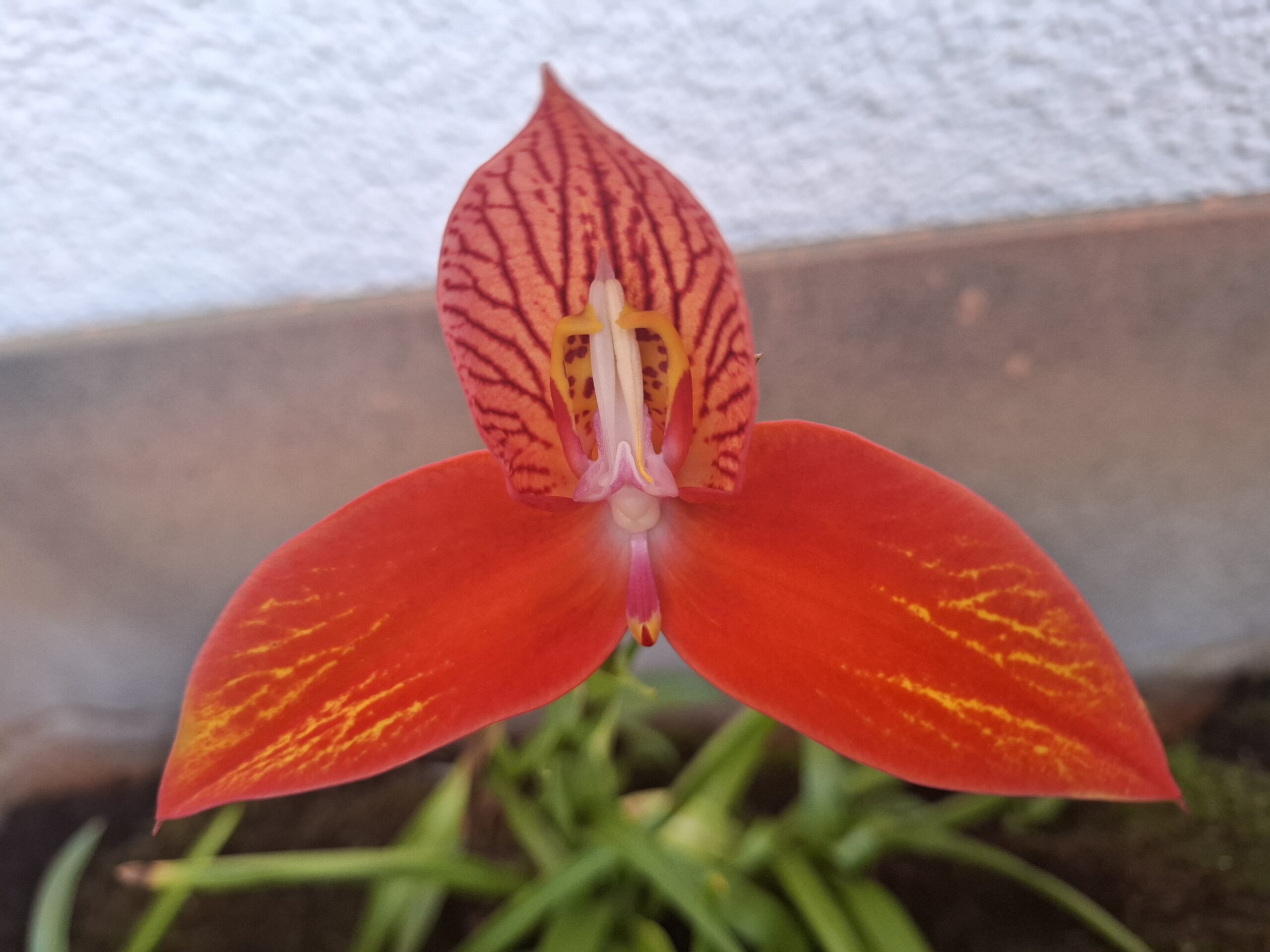
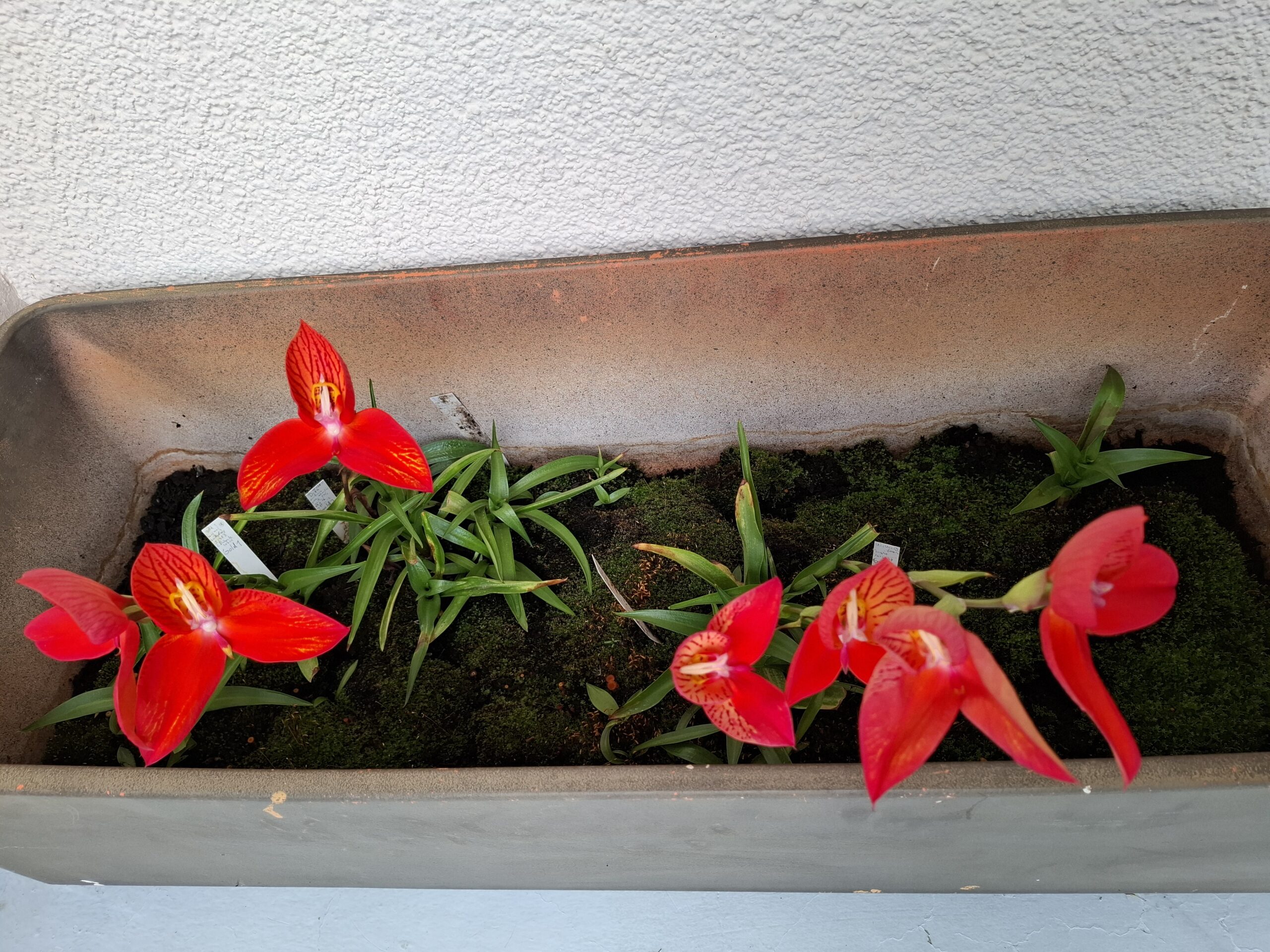
Disa uniflora:
Section uniflora. Robust plants, up to 60 cm tall, with very large flowers. The up to 8 oblong basal leaves are unspotted. Flowers are red with some carmine, yellow, or orange. Flowering time in the Northern Hemisphere is June to July. The plants reproduce by runners (stolons). Disa x Unifoam is a hybrid with its own name, a cross between Disa morio and Disa longicorno.
Cultivation:
Disa uniflora grows in South Africa, in the Western Cape. Winters are cool and damp, and summers are warm and dry. The plants grow along permanently moist streams at altitudes between 100 and 1200 meters. The main growing season is during the warm spring months. The plants remain green year-round. Water Disa uniflora regularly and keep the soil moist. For potted plants, use a saucer to ensure the soil is slightly submerged. Cultivate in a bright, sunny location. Allow slightly less water after flowering and during the winter.
Recommended soil mixtures:
Disa uniflora has so far only been successfully cultivated in acidic, organic soils. Sphagnum moss is very suitable, but is no longer recommended for conservation reasons. The alternative, white peat, also yields good results. Fertilize with slow-release fertilizer; add 1g of Klanz autumn fertilizer to the bottom of the pot. A mixture of equal parts wood fiber and Floragard Rhodohum is also recommended. The wood fibers create a more aerated and nutrient-poor substrate and serve as food for the mycorrhizal fungi. In nature, Disa uniflora is always infected by mycorrhizal fungi. These fungi are also important for the growth and health of the plants in pot cultivation.
Recommended reading:
Wild orchids of Southern Africa. J. Stuart, H.P. Linder, E.A. Schelpe, A.V. Hall, 1982. Macmillan South Africa.(Publishers)(Pty)Ltd. ISBN 0 86954 070 X.
Growing South African indigenous orchids. Karsten, B. Woodrich, 1997.Balkema ISBN 90 5410 650 6.
Orchids of Kenia. Joyce Stuart, 1996. St Pauls Bibliographies,Winchester.ISBN 1 873040 28 8.
Orchids of Southern Africa. HP Linder and H. Kurzweil, 1999. AA Balkema/Rotterdam/Brookfield. ISBN 90 5410 4457.